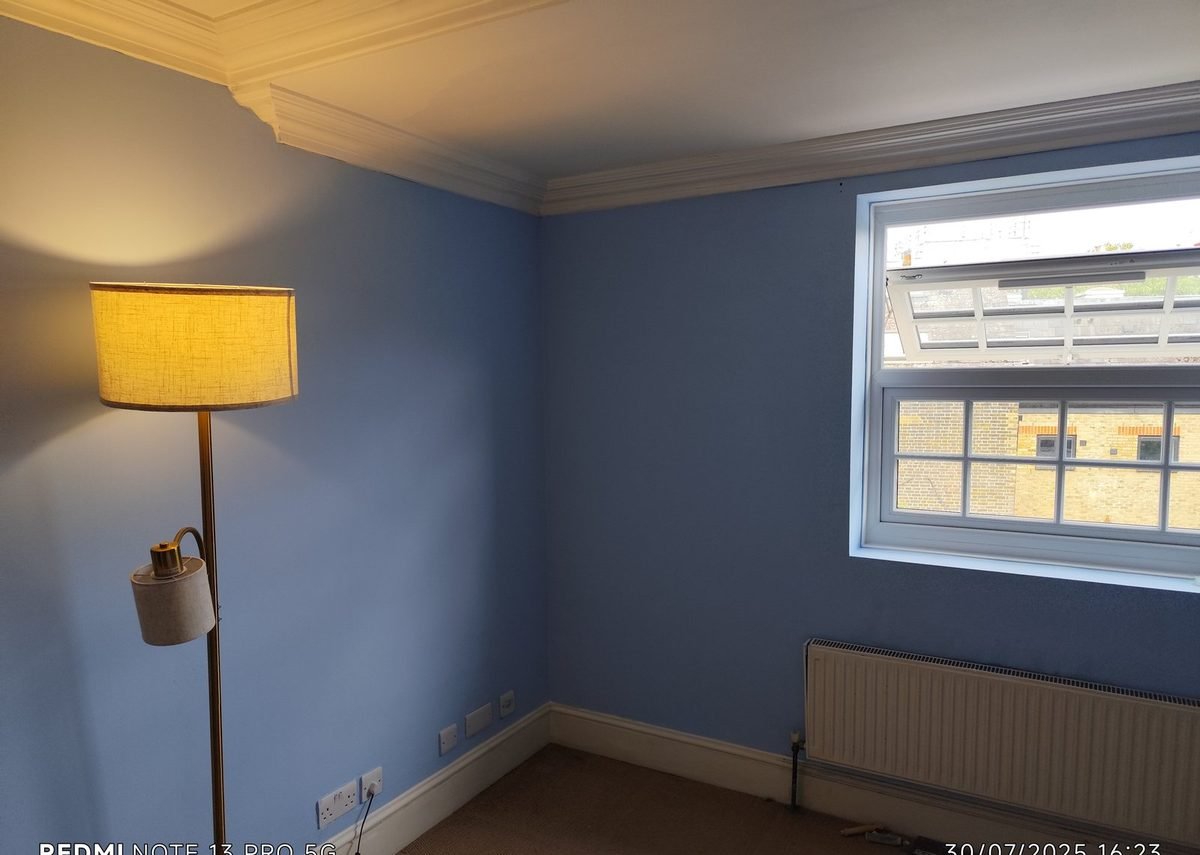
If you’ve ever wondered why painting a Victorian terrace feels completely different from painting a modern new-build flat, you’re not imagining it. The two couldn’t be more different — and if you approach them the same way, you’re going to have problems. I’ve painted both for over a decade across South London, and here’s exactly what changes between the two, and how to get it right in either.
The Walls: Lime Plaster vs Plasterboard
This is the biggest difference, and it affects everything else. Victorian and Edwardian properties (pre-1919) were built with solid brick walls covered in lime plaster. New builds and modern conversions use plasterboard (drywall) with a thin skim coat of gypsum plaster.
Lime plaster is porous. It was designed to breathe — moisture passes through it, which helps regulate humidity in the room. If you seal it with modern vinyl paints, you trap that moisture inside the wall, and eventually the plaster blows. I’ve seen entire Victorian hallway walls need replastering because someone in the 1990s slapped vinyl silk over the original lime.
The rule for Victorian walls: use breathable paint. A quality matt emulsion like Dulux Trade Diamond Matt is my default — it’s durable enough for high-traffic areas but still lets the wall breathe. Avoid vinyl silk and acrylic eggshell on lime plaster unless you’re 100% sure the walls have been tanked or are bone dry.
New-build plasterboard is the opposite: it’s smooth, uniform, and relatively non-porous. You can use almost any paint on it. The challenge isn’t the material — it’s the drying time. New plaster needs to dry completely before you paint it. In a new build, the developer almost certainly didn’t wait long enough. If you paint over damp plaster, the paint will peel within weeks. Test with a moisture meter before you start — anything above 2% moisture content and you need to wait longer.
Cracks: Where They Come From and How to Fix Them
Victorian houses move. The foundations are shallow, the brickwork expands and contracts with the seasons, and after 120+ years, every wall has settled into its final position — more or less. Hairline cracks along cornices, above door frames, and at wall-ceiling joints are completely normal. They’re usually cosmetic and easily fixed with Toupret filler and a fine sanding block.
New builds crack differently. The building is still settling — sometimes for the first 2-3 years after construction. Cracks tend to appear at plasterboard joints and around window reveals as the timber frame dries out. The frustrating thing about new-build cracks is that they often come back after you’ve filled them. The only permanent fix is to tape the joint with scrim tape, fill over it, and repaint — which is more work than most people expect from a “brand new” property.
Ceiling Height: It Changes Everything
Victorian ceilings are high — often 2.7m to 3.3m. New-build ceilings hover around 2.4m. That doesn’t sound like a big difference on paper, but when you’re on a ladder with a roller in one hand and a paint tray balanced on the top step, those extra 60cm feel like a mile.
High ceilings need more paint (obviously), but they also change the colour psychology. Darker colours that would make a low new-build room feel like a coffin can look dramatic and elegant in a Victorian room. Meanwhile, a very light colour in a high-ceilinged room can feel cold and institutional. I always recommend testing a large patch — at least a metre square — before committing to a colour in a Victorian room. The light behaves differently at height.
For the actual painting: an extension pole for your roller is non-negotiable in a Victorian house. A quality roller sleeve on a pole will save your shoulders and give you a much more consistent finish than stretching from a ladder. In new builds, you can get away without one, but it still makes the job faster.
Windows: Sash vs Double-Glazed Units
Victorian sash windows are beautiful. They’re also a complete pain to paint around. Each sash has multiple frames, cords, weights, and a narrow gap between the inner and outer sash that you somehow need to get a brush into. If you’re painting the window frames themselves (not just the wall around them), factor in at least an hour per window for a proper job. You need a quality angled brush for the tight corners — a straight brush will drive you mad.
New-build windows are simpler: a single uPVC or aluminium frame with clean edges. Masking tape around the frame — using FrogTape, not the cheap stuff — gives you a crisp line in seconds. The main risk with new builds is that the window silicone sealant is still fresh, and paint doesn’t adhere to fresh silicone. Wait at least a week after the silicone was applied before painting anywhere near it.
Surface Imperfections: Character vs Flaws
Victorian walls are never truly flat. They have undulations, slight bows, and the odd bump from 100 years of previous decorating decisions. This isn’t a flaw — it’s character. But it does change how paint looks on the wall. High-sheen finishes (silk, gloss) will highlight every single imperfection. Matt finishes hide them. If your Victorian wall looks like a minor topographical map, stick to matt — you’ll be much happier with the result.
New-build walls are machine-flat by comparison. You can use any finish you like — eggshell, satin, even gloss — and the wall won’t betray you. This is one area where new builds genuinely have the advantage. A satin finish in a new-build living room can look stunning, where the same finish in a Victorian room would look like the wall was having a bad day.
Dust, Damp, and Other London Surprises
Victorian houses in London almost always have some level of damp somewhere. It might be a tiny patch behind the sofa where the external wall gets cold, or a more serious issue around the chimney breast. Before painting, you need to know what you’re dealing with. Sugar soap will clean surface mould and grease, but it won’t fix an underlying damp problem. If there’s active damp, sort that first — painting over it is like putting a plaster on a broken leg.
New builds have their own issues. The dust from construction — fine plaster dust — gets absolutely everywhere. Even if the flat looks clean, the walls will have a microscopic layer of dust that paint won’t adhere to properly. Wash every surface with sugar soap before you start, even if it “looks fine.” I learned this the hard way on a new-build in Vauxhall where the first coat literally slid off the wall.
Which Is Easier to Paint?
Honest answer: new builds are much easier. The walls are flat, the surfaces are predictable, and there are fewer nasty surprises waiting for you. A competent DIYer can paint a new-build flat to a professional standard in a weekend with the right tools.
Victorian properties reward experience. The challenges — uneven walls, high ceilings, sash windows, potential damp issues, lime plaster considerations — mean that a professional who’s seen it all before will work faster and get better results than even a very capable DIYer facing it for the first time. I’m not saying you can’t do it yourself. I’m saying budget twice the time you think it’ll take, and don’t be surprised if you uncover something unexpected behind the old wallpaper.
Need a Professional?
Whether you’re in a Victorian terrace in Brixton or a new-build flat in Battersea, I’ve painted it before. I know what to look for, what products to use, and how to get a finish that lasts. Every job starts with a free visit where I’ll assess your walls properly — because the quote you get should be based on what’s actually there, not what you think is there.
Get your free quote here. Covering Brixton, Peckham, Camberwell, Clapham, Battersea, Streatham, Dulwich, Herne Hill, Stockwell, Kennington, Vauxhall, and across South London.
Product links are affiliate links. As an Amazon Associate, I earn from qualifying purchases. I only recommend products I use on paying jobs every week.